Build on existing workflows
Without replacing core systems or monitoring products, receive records via API and return decision results to existing workflows.

ARCHAIC / AI DECISION GATEWAY
Enterprise AI data analysis powered by Jev
Not everything belongs with people. Not everything belongs with generative AI.
Combining structured decisions by Jev, detailed LLM analysis and human review, we support the path from decisions to integration with existing workflows.
Add a layer downstream of existing systems, without replacing them.
Synchronous and asynchronous processing to suit your operations.
Structured decisions among predefined options
A conceptual view of how decision responsibilities are shared
PRESS RELEASE / 2026.10.01
Archaic develops an enterprise AI data analysis platform powered by TypeSafe AI’s Jev
ABOUT JEV
Jev is a System 1 Decision Model provided by TypeSafe AI. Unlike general-purpose text-generating LLMs, it returns typed, probabilistic decision results for predefined options.
Archaic’s platform uses Jev to triage and classify large volumes of data, routing only cases that need detailed analysis to LLMs or people.
Performance, accuracy and cost vary with usage conditions and the data involved. We will validate accuracy, speed and operational suitability for each use case with real business data.
WHY THIS GATEWAY
Logs, transactions, inquiries, applications and manufacturing records accumulate every day.
A layer added to existing workflows supports decisions that simple rules or reviewing every record alone struggle to handle.
Without replacing core systems or monitoring products, receive records via API and return decision results to existing workflows.
Combine new records with historical data for evaluation by user, customer, device, case, manufacturing lot or another relevant grouping.
Use Jev to triage cases, sending only those that need detailed analysis to an LLM. Route high-risk or low-confidence cases to people for final review.
HOW IT WORKS
Manage decision paths and results through the fixed flow “JUDGE → THINK / REVIEW / ACT.”
Rather than applying LLM analysis or human review to every record, configured rules determine where each case is processed.
Receive records via API and group them using keys suited to your workflow. Include the history of the same subject in the decision.
Return a structured decision, confidence and risk for predefined options.
Use an LLM to analyze the reasons when needed. Hand cases to the responsible person according to the rules and confirm the final decision.
Save final results and notify existing systems via Webhook according to the settings for each decision.
USE CASES
The following are potential use cases. Joint validation with real data will assess suitability and effectiveness for each workflow.
Select the next model, tool or person based on inputs, permissions, cost, risk and history. Hand only exceptions to an LLM or a person.
Combine transaction amounts, frequency, devices, locations and account changes to determine response priorities and cases for review.
Aggregate large volumes of alerts and prioritize responses based on severity, scope of impact and relationships with past events.
Use inquiries alongside contract, usage and past support information to determine urgency, the responsible team, response approach and whether escalation is needed.
Classify applications, contract-related documents, posts, advertisements and product information. Route them for publication, approval, revision or human review.
Evaluate the history of equipment, sites, processes, lots and cases. Identify items for review from combinations that simple thresholds may miss.
VISIBLE DECISIONS
Record inputs, decision stages, applied conditions, human review and final results as transactions.
Use these records for audits, operational improvements and rule revisions.
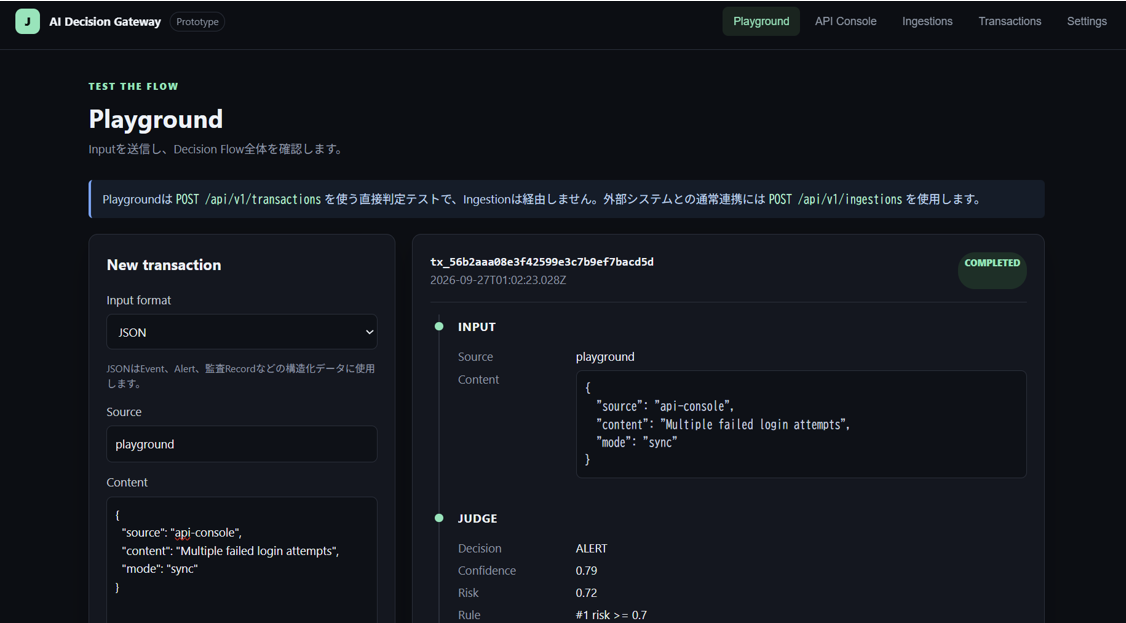
Inspect individual decision results and the stages each case passed through. See how responsibilities are shared among Jev, LLMs and people.
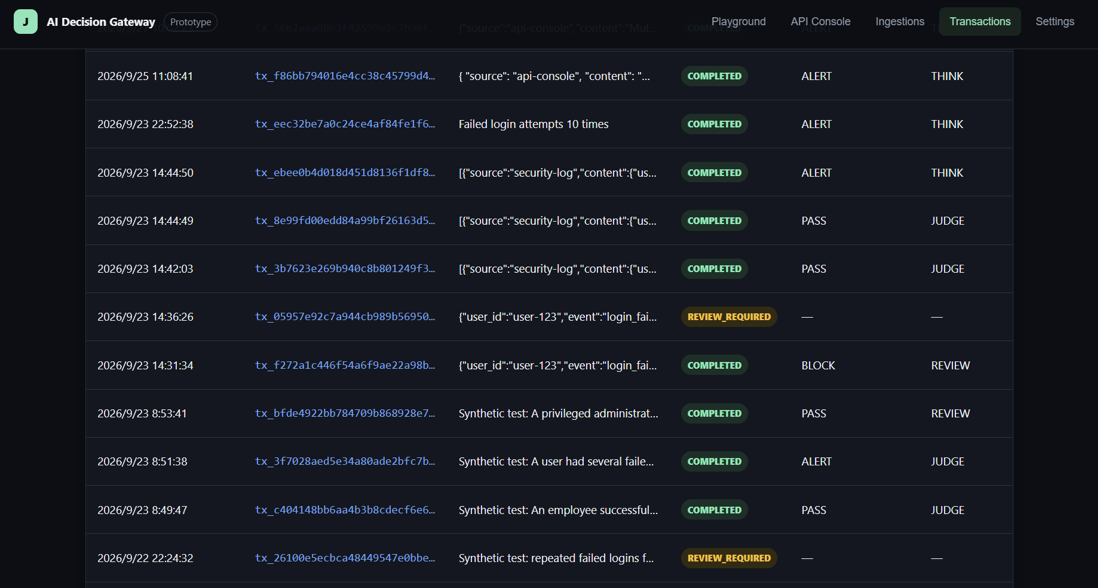
The screens shown are from a prototype.
List execution times, inputs, processing status, final decisions and the stages that produced them. Use asynchronously accumulated results in ongoing operations as well.
Webhook settings for each decision let you send results to existing systems and notification destinations.
SYNC / IMMEDIATE DECISIONS
Immediately process records received via API together with the history of the same group. Return decision results and a tracking ID.
Transaction fraud checks / Application intake / Operator assistanceASYNC / EVALUATING ACCUMULATED DATA
Retrieve accumulated records using count- or time-based triggers and evaluate each group. Results can be viewed via API or the management interface.
Security logs / Transaction history / Operational auditsBEFORE YOU START
Replacement is not a prerequisite. The platform is added downstream of existing systems and evaluates records received via API. Integration methods and data formats will be designed during joint validation.
No. Cases are routed to human review based on risk, confidence and business rules. The platform is not intended for uses that leave decisions involving human lives or fundamental rights, or controls directly affecting safety, solely to AI.
The current prototype supports a PUSH-type API, synchronous and asynchronous processing, group and history evaluation, decision records, human review and Webhooks. PULL-type connectors, distributed queues, automatic retries and job recovery are not yet implemented. Authentication and permissions, data protection, retention policies, availability and other requirements will be designed and validated separately for production implementation.
We welcome discussions on joint validation and business partnerships, including integration into existing products, OEM and white-label arrangements. Terms and costs will be considered individually after reviewing the target workflow and implementation scope.
BUILD WITH ARCHAIC
For companies looking to narrow down cases for review, and businesses seeking to embed AI decision capabilities in existing products.
Together, we will define the relevant data and decision criteria, then consider everything from evaluation with real data to integration and operational design.
This opens the contact page. Please mention “AI Decision Gateway / Jev” in your inquiry.